Sacred Art

Art that quiets the heart and turns it toward God. For centuries, Christians have painted, carved, and set glass in light, not to decorate, but to open a window to heaven.

Christ Pantocrator, 6th century, Saint Catherine's Monastery, Sinai

A Window to Heaven, not a Decoration

In the Orthodox, Byzantine, and Catholic traditions, sacred art is a kind of theology you can see. It teaches the faith, and it invites us to slow down, look, and pray. A good icon or painting doesn’t ask to be admired; it asks to be looked through, toward the One it shows.

“Blessed are the pure in heart, for they shall see God” (Matthew 5:8). Sacred art is one gentle way of training the heart to see.

Icons of the East

Byzantine and Orthodox icons belong to the Church’s prayer and worship. They don’t try to look like a photograph. Instead, they show the saints and Christ as they are in the Kingdom of Heaven: transfigured, calm, and full of light.

  • Gold backgrounds stand for the light of heaven.
  • Reverse perspective makes the lines open toward you, as if the icon is drawing you in.
  • Large, quiet eyes and still faces invite stillness in the one who prays.

Iconographers traditionally prepare with prayer and fasting, and many old icons are unsigned. The painter serves the tradition of the Church rather than making a name for themselves.

About the saints: we don’t worship the saints, and they never take the place of God. Worship belongs to God alone: Father, Son, and Holy Spirit. We honor the saints as heroes of the faith, a “great cloud of witnesses” (Hebrews 12:1) whose lives show us how to follow Jesus. As St. Paul wrote, “Be imitators of me, as I am of Christ” (1 Corinthians 11:1). And just as we ask a friend to pray for us, we can ask the saints to pray for us too: “pray for one another… The prayer of a righteous man has great power in its effects” (James 5:16). They pray with us and for us, but our prayer always rises to God.

The Holy Trinity, Andrei Rublev, early 1400s
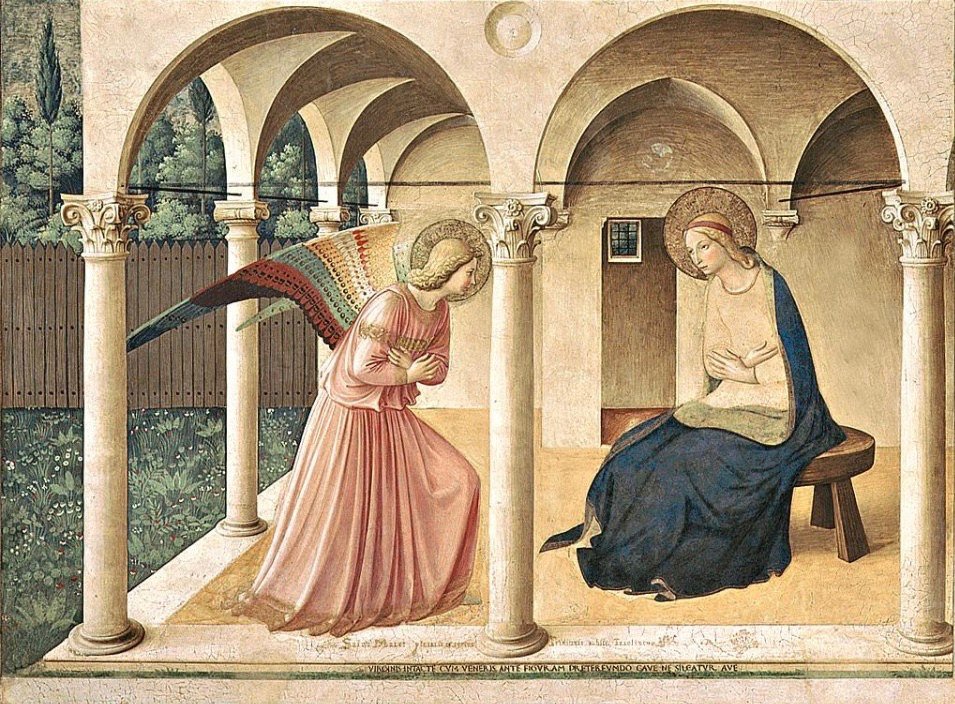
The Annunciation, Fra Angelico, about 1440, San Marco, Florence

The Western tradition

The Catholic Church shares the East’s defense of holy images, set out at the Second Council of Nicaea in 787, and Catholics pray with Eastern icons too. Pope St. Gregory the Great wrote that pictures teach those who cannot read, and Western churches became Bibles in paint, stone, and glass.

Over the centuries, Western sacred art grew from medieval panels into Renaissance and Baroque painting: real space, real bodies, and deep feeling. It gave us statues, crucifixes, carved altars, and stained-glass windows, and its artists usually signed their work, bringing their own gifts to the same Gospel.

East and West, side by side

Two ways of seeing, one faith. Neither is better; each helps the heart in its own way.

This isn’t here to change anyone’s faith. Wherever you come from, you’re warmly invited to borrow what helps: a quiet image, a candle, a few slow minutes of stillness. Let these old ways make a little room in your home and in your day to rest, breathe, and turn your heart to God. Our one hope is to help you draw close to God the Father, to Jesus, and to the Holy Spirit, and to find His peace in your soul: “Peace I leave with you; my peace I give to you” (John 14:27).

Byzantine and OrthodoxCatholic (Western)
PurposePresence in worship, contemplation, and transformationTeaching, feeling, and devotion
StyleFlat, stylized, reverse perspective, gold lightReal space and bodies, perspective, light and shadow
FormsPanel icons, mosaics, frescoes; few statuesPaintings, frescoes, statues, crucifixes, stained glass
The artistTraditionally humble and often unsignedUsually signed, with a personal style
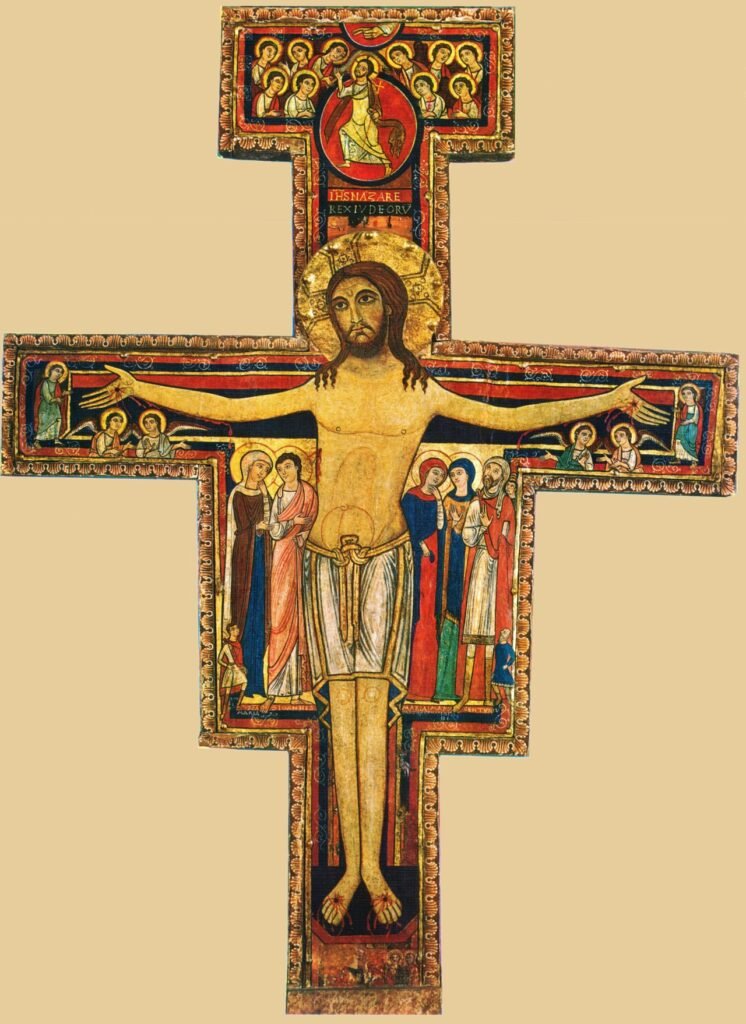
The San Damiano Cross, 12th century, Assisi: a Western cross painted in the Eastern style
St. Francis Preaching to the Birds, Giotto (attributed), about 1300, Assisi

The Franciscan way: all creation sings

St. Francis was praying before a painted crucifix, the San Damiano Cross, when he heard the words, “Francis, go and repair my house.” In 1223 at Greccio he set up the first living Nativity scene, so people could see the humility of Christ’s birth with their own eyes.

For Francis, creation itself was sacred art: Brother Sun, Sister Moon, the birds, and the flowers of the field all praise their Maker. It’s why we paint herbs, insects, and growing things here: every leaf can lead us back to God.

From the very beginning, a garden was where God met His people. “The LORD God took the man and put him in the garden of Eden to till it and keep it” (Genesis 2:15), giving it to us to tend, protect, and honor. And in the evening, Adam and Eve “heard the sound of the LORD God walking in the garden in the cool of the day” (Genesis 3:8). Every garden we care for, and every leaf we paint, is a small echo of Eden.

The Benedictine way: work as prayer

The Rule of St. Benedict asks artisans in the monastery to practice their craft with humility, “so that in all things God may be glorified.” Benedictine monks copied and painted manuscripts by hand, and the work itself became prayer: ora et labora, pray and work.

Monks often meditated as they painted and copied the Scriptures, slowly turning each word over in the heart as the pen moved. This prayerful way of reading is called Lectio Divina, “divine reading,” and St. Benedict set aside time for it every day:

  1. Read (lectio) a short passage slowly, more than once.
  2. Reflect (meditatio) on a word or phrase that stays with you.
  3. Respond (oratio) to God in your own words.
  4. Rest (contemplatio) quietly in His presence.

This slow, steady prayer brought the monks deep peace, and that peace overflowed into love for others. The Rule asks that every guest be welcomed as Christ, and monasteries became places of hospitality, care for the sick, and help for the poor.

Painting can be the same. Mixing a color, waiting for a wash to dry, and laying down one careful line at a time is a practice of patience and peace. Try reading a verse before you paint, and let it stay with you as you work.

Life of St. Benedict, Sodoma, about 1505, Monte Oliveto Maggiore
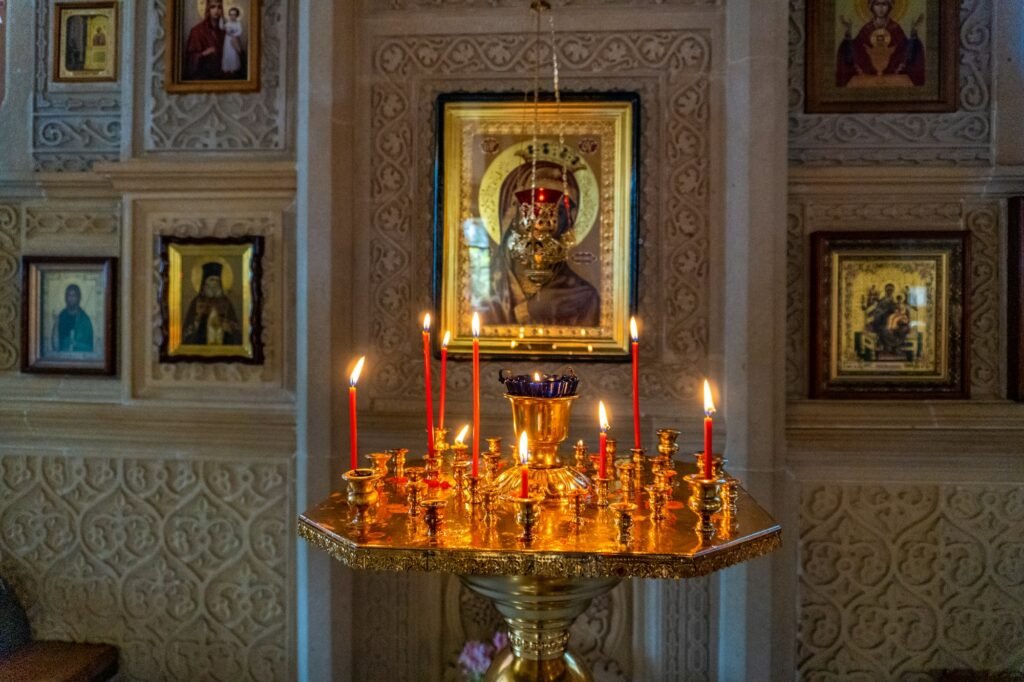
A golden censer before an icon of Christ, Church of the Transfiguration, Brus

Incense: prayer rising like smoke

Incense runs through the whole Bible, from the Old Testament to the New. In the tabernacle, God asked for an altar of incense to burn every morning and evening (Exodus 30:7–8). The psalmist prayed, “Let my prayer be counted as incense before thee” (Psalm 141:2). Zechariah was offering incense in the Temple while the people prayed outside when the angel came to him (Luke 1:9–11), and the Magi brought the Christ Child frankincense and myrrh (Matthew 2:11). In heaven, “the smoke of the incense rose with the prayers of the saints from the hand of the angel before God” (Revelation 8:4).

What began in the worship of the Old Testament carried on in the Church. The first Christians held back at first, because incense was being offered to the Roman emperor and the pagan gods, but by the fourth century it had become part of Christian prayer: the pilgrim Egeria described incense filling the Church of the Holy Sepulchre in Jerusalem. The early Church Fathers and the monastic tradition that grew from the Desert Fathers carried it forward, and the Church has kept it ever since. Catholic and Orthodox liturgies still use incense, and many Orthodox families gently cense their icon corner at home. Frankincense and myrrh are tree resins: gifts from creation itself, rising as prayer.

Burn it safely: use a small amount in a heat-proof holder, keep the room aired out, never leave it burning alone, and keep it away from children and pets. If smoke bothers your breathing, a candle alone is just as good a prayer.

Sacred art in your prayer corner

If a piece of art brings you peace when you pray or meditate, let it be part of your prayer space. The goal isn’t to pray to the picture. It’s to help quiet the mind, settle the heart, and turn your attention to God. As the early Church taught, the honor we show an image passes on to the one it shows.

The same is true of the saints. An icon of a saint never replaces God. The saints are heroes we admire for what they did and how they lived, examples who help lead us closer to God the Father, to Jesus, and to the Holy Spirit.

All are welcome here. We are all sinners, for “all have sinned and fall short of the glory of God” (Romans 3:23), and none of us has finished the journey. Judging others is not ours to do: “Judge not, that you be not judged” (Matthew 7:1). We are here only to help you find a little more happiness and peace. Whether you share this faith or not, you are welcome to use these quiet practices on your own path toward light and peace.

If someone judges you, let it pass gently, like a breeze through the garden. They, too, are still learning, with more to read and more to practice, as all of us do. There is no need to argue or to defend yourself. Simply say a quiet prayer for them, and return to your stillness. “If possible, so far as it depends upon you, live peaceably with all” (Romans 12:18).

This is why this place was made: to serve and help others, within the Church and beyond it, and to teach the gentle art of praying alone, as Jesus taught us: “When you pray, go into your room and shut the door and pray to your Father who is in secret” (Matthew 6:6).

A conversation with God. When we read the Bible, God speaks to us. When we pray, we answer Him from the heart. St. Ambrose put it simply: we speak to God when we pray, and we listen to Him when we read His word. “For the word of God is living and active” (Hebrews 4:12), and He promises, “You will seek me and find me; when you seek me with all your heart” (Jeremiah 29:13). Your prayer corner is a quiet place for that conversation.

  1. Choose one image that draws you into stillness: an icon, a cross, or a painting you love.
  2. Give it a simple place at eye level, with a candle or a small plant nearby.
  3. Light a little incense if it helps you settle, and let the rising smoke remind you that your prayer rises to God.
  4. Sit and look slowly for a few minutes before you pray. Let your breathing slow down.
  5. Rest there: “Be still, and know that I am God” (Psalm 46:10).

Scripture quotations are from the Revised Standard Version (RSV).
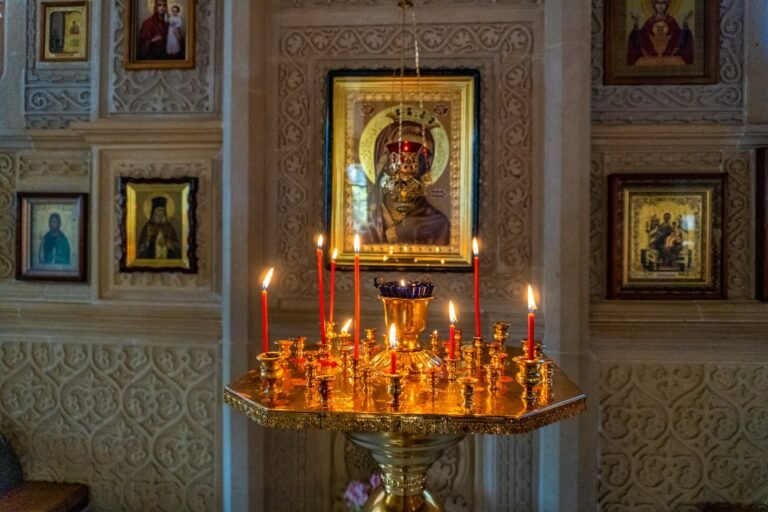
Icons on a church wall with lit candles in a brass stand
Icons and candles in a church

From the Sacred Art blog

Praying with icons, the stories behind holy images, and sacred art in progress from the studio.

Follow the journey

New posts, workshop dates, and gallery shows, sent to your inbox. Art news only.